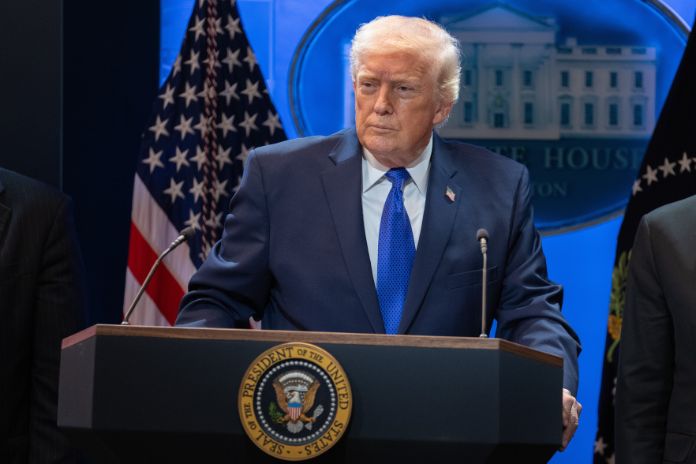
President Donald Trump declared on March 6, 2026, that the United States will accept no deal with Iran short of its “unconditional surrender.” In a stark Truth Social post, he envisioned a transformed Iran post-surrender—economically stronger and thriving under the banner “MAKE IRAN GREAT AGAIN (MIGA!).” This hardline stance escalates amid ongoing US and Israeli military operations targeting Iran’s nuclear sites, leadership, and forces.
Trump’s words echo his earlier June 2025 calls for surrender and follow recent US airstrikes on key Iranian facilities. He has also promised immunity to members of Iran’s Revolutionary Guard Corps (IRGC) and police who lay down arms, warning others of “certain death.” The message underscores America’s position: Iran must fully capitulate or face intensified action.
Iran’s Mediation Overture
Hours later, Iranian President Masoud Pezeshkian responded via X, confirming that “some countries have begun mediation efforts” to halt the war with the US and Israel. He stressed Iran’s openness to “lasting peace” but only if talks address those who “underestimated the Iranian people and ignited this conflict.” Pezeshkian affirmed Tehran’s resolve to defend its sovereignty without backing down.
This marks a potential diplomatic window, though details on mediators remain vague. Past efforts involved Russia, Oman, Turkey, and Qatar, but yielded little progress. Recent indirect US-Iran talks in Vienna ended in February 2026 with vague claims of headway, stalled by disputes over nukes, missiles, and sanctions.
Roots of the Escalation
Tensions exploded last week with nationwide US and Israeli strikes on Tehran, hitting Iran’s top command, nuclear program, and military assets. Iran retaliated with missile barrages, drawing sharper US air campaigns. Trump’s rhetoric frames the conflict as a regime showdown, urging internal collapse in Iran.
The US leader’s demands hark back to January 2026 warnings: end nuclear ambitions and halt protester crackdowns, or risk full military response. Analysts see this as maximum pressure tactics, blending threats with selective incentives like immunity offers.
Global Stakes and Outlook
The clash risks wider Middle East turmoil, with oil markets jittery and allies watching closely. Trump’s “no deal” line signals diplomacy’s slim odds unless Iran folds entirely. Yet Pezeshkian’s nod to mediation hints at backchannel maneuvering, possibly via neutral powers.
For Iran, balancing defense and de-escalation tests its leadership amid economic strain from sanctions. The world awaits if third-party talks gain traction or if strikes dominate. As Trump pushes for total victory, Pezeshkian’s measured tone suggests Tehran seeks an off-ramp without humiliation.