Dramatic clashes and fighting ensued between Pakistan and Afghanistan on Friday, with Islamabad announcing an “open war” against Kabul, following Afghanistan’s attack on Pakistan’s border outposts and military positions, which the Afghan Taliban said was in retaliation of Pakistan airstrikes earlier inside Afghanistan that hit different areas in Kandahar, Kabul, and Paktia.
The latest flare-up marks one of the sharpest escalations in recent years along the disputed Durand Line, which is a colonial-era border that Afghanistan has never formally accepted. Both sides have accused each other of violating territory, sheltering militants, and targeting civilians.
Pakistan’s Defence Minister Khawaja Asif, in a post on X, said Islamabad had run out of patience with the Taliban-led administration. He accused authorities in Kabul of allowing militants to operate from Afghan soil and exporting violence across the border.
“After the withdrawal of NATO forces, it was expected that there would be peace in Afghanistan… They gathered terrorists from around the world and began exporting terrorism,” he wrote. He also alleged that the Afghan leadership had curtailed basic rights, including those of women.
“Our cup of patience has overflowed. Now it is open war between us and you. Now it will be ‘Dama Dam Mast Qalandar’. Pakistan’s army did not come from across the seas. We are your neighbours; we know your ins and outs. Allahu Akbar,” the Pakistani Defence Minister added, as per news agency ANI.
Airstrikes and retaliation claims
Afghanistan’s Taliban spokesperson Zabihullah Mujahid confirmed that Pakistani aircraft had struck areas in Kabul, Kandahar and Paktia. Calling the action “cowardly”, he said there were no immediate reports of casualties.
“The cowardly Pakistani military has carried out airstrikes in certain areas of Kabul, Kandahar, and Paktia; fortunately, there have been no reported casualties,” said Mujahid in a statement on X.
Meanwhile, Afghanistan’s Ministry of National Defence claimed its forces had carried out retaliatory operations along the Durand Line on Thursday evening. In a statement, the ministry said 55 Pakistani soldiers were killed, two military bases destroyed, and 19 posts captured during a four-hour operation that began at 8:00 PM on the 9th of Ramadan (February 26).
The ministry alleged that Pakistani forces had breached Afghan territory days earlier, resulting in the deaths of women and children. It also said eight Afghan fighters were killed and 11 injured in the counter-operation. Additionally, it claimed that 13 civilians were hurt in a missile strike on a refugee camp in Nangarhar.
Afghan authorities said operations targeted posts near Khost, Paktia, Nangarhar, Paktika, Kunar, and Nuristan. They further claimed that weapons and military vehicles were seized during the clashes.
Pakistan, meanwhile, said it had launched an operation named ‘Ghazab Lil Haq’ targeting the Afghan Taliban regime, according to ARY News. Prime Minister’s spokesperson Mosharraf Zaidi stated that 133 Afghan Taliban fighters were killed and more than 200 injured. Pakistani forces also reportedly destroyed 27 Taliban posts and captured nine others, Geo News reported.
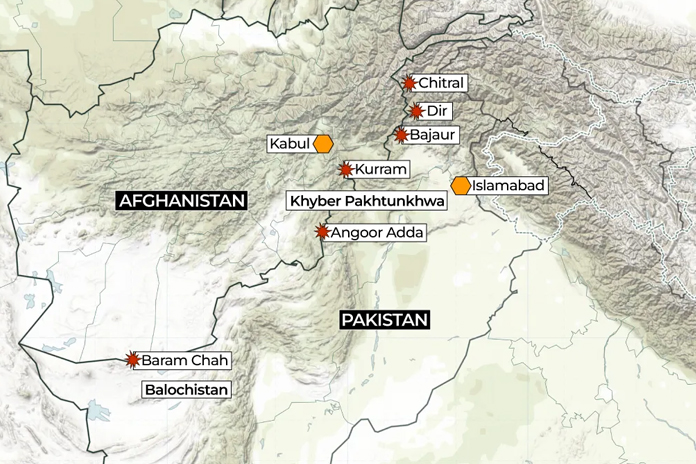
Security operations were said to have taken place across border districts including Chitral, Khyber, Mohmand, Kurram and Bajaur.
Karzai condemns airstrikes
Former Afghan president Hamid Karzai strongly criticised what he described as renewed Pakistani bombing of Afghan cities. In a post on X, he said Afghans would defend their homeland “with complete unity in all circumstances” and respond firmly to any aggression.
Karzai accused Islamabad of continuing a pattern of military pressure instead of addressing its internal security challenges. He said Pakistan would not escape violence through cross-border attacks and urged it to adopt what he called a path of “good neighbourliness, respect and civilised relations”.
The 2,611-kilometre Durand Line has long been a source of tension between the two neighbours. Drawn in the 19th century during British rule, the border remains contested, fuelling periodic clashes and diplomatic stand-offs.