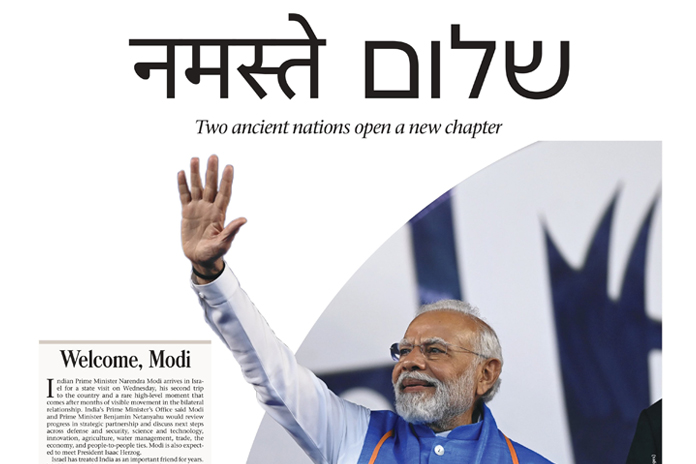
Prime Minister Narendra Modi has embarked on a significant and historic visit to Israel today on 25 February 2026. In both Jerusalem and New Delhi, the visit is being seen as more than just routine diplomatic engagement. Officials in the government of India have termed the bilateral visit a ‘reaffirmation of a strategic relationship that has matured steadily, confidently, and unapologetically since July 2017’ – when PM Modi became the first Indian Prime Minister to visit Israel.
That moment marked a decisive break from decades of hesitation and ideological diffidence in India’s West Asia policy.
What followed has been one of the most consequential realignments in India’s contemporary foreign relations. For years after recognising Israel in 1950, India had kept the relationship understated, often subordinated to domestic political optics and Cold War-era ideological positioning. Engagement existed, but it was deliberately kept out of sight. The 2017 visit changed that paradigm. It signalled that India would no longer allow its strategic interests to be constrained by inherited dogmas or performative moral posturing. Since then, India-Israel ties have deepened across defence, security, te chnology, innovation and people-to-people exchanges.
The relationship has evolved from quiet cooperation to an open strategic partnership anchored in trust and results. The most visible pillar of this partnership is defence and security. Israel today is among India’s top defence partners, with cumulative defence cooperation exceeding USD 10 billion. Israeli systems play a critical role in India’s missile defence, surveillance, border security, drones, electronic warfare and intelligence capabilities. More importantly, the relationship has moved beyond buyer-seller dynamics to joint development and co-production-fully aligned with India’s push for indigenisation and strategic autonomy. This trust did not emerge overnight.
Israel has stood by India during its challenging moments, including the 1971 war and the 1999 Kargil conflict, offering timely and practical support when many others hesitated. Such reliability matters deeply in matters of national security, and New Delhi has neither forgotten nor discounted it. Yet to see the India-Israel partnership only through a defence lens would be to miss its most transformative dimension: technology and innovation. Israel’s reputation as a global innovation hub complements India’s scale, talent pool and growing digital ecosystem.
Cooperation now spans artificial intelligence, cybersecurity, fintech, agri-tech, water management, and healthcare technologies. Israeli expertise in drip irrigation and water recycling has found natural application in Indian agriculture, while joint innovation platforms link start-ups, universities and research institutions in both countries. This is not aid, nor asymmetrical dependence. It is co-creation – two entrepreneurial societies leveraging their comparative strengths to address future challenges. Bilateral trade (excluding defence) has grown from around USD 4 billion in 2017 to over USD 7 billion, with high-technology sectors leading the way.
Beyond strategy and technology lies a deeper cultural symmetry that often goes unremarked. India and Israel are civilisations shaped by resilience. Both peoples carry the memory of centuries marked by adversity, displacement and external threats. Survival, adaptation and renewal are embedded in their national consciousness. In recent decades, this historical resilience has translated into extraordinary enterprise – start-ups, innovation, scientific excellence and global ambition. There is also a quiet historical bond. The Jewish community lived in India for centuries without persecution, a fact frequently cited in Israel as a testament to India’s civilisational pluralism.
This shared respect for history and identity adds a human depth to the bilateral relationship that goes beyond transactional diplomacy. One of the most consequential shifts under PM Modi has been India’s clear-eyed recalibration of its Israel-Palestine policy. Previous governments, particularly under the Indian National Congress, often adopted a posture that was outwardly pro-Palestine but inwardly evasive towards Israel. This approach, driven largely by domestic appeasement politics, resulted in a foreign policy that was neither honest nor effective. The Modi government corrected this imbalance through a policy of de-hyphenation. India did not abandon its principled support for the legitimate Palestinian cause.
At the same time, it chose to normalise and strengthen ties with Israel on their own merit. This was not ideological alignment but sovereign decision-making, recognising that India’s interests are best served by engaging both sides independently. Crucially, Israel has respected India’s strategic autonomy. India is not expected to support Israel at every vote in multilateral forums, and Israel understands India’s regional sensitivities. This mutual respect is the hallmark of mature statecraft, not of transactional alliances. India and Israel also share a grim but unifying experience: decades of terrorism. Both nations have confronted terror not as an abstract threat but as a lived reality – against civilians, institutions, and democratic life itself.
Their zero-tolerance approach to terrorism is grounded in experience, not rhetoric. Cooperation in intelligence sharing, counter-terror training, urban security and aviation protection has become a critical component of India’s internal security framework. Against this backdrop, the attempts by the contemporary Congress leadership to undermine or moralise India-Israel relations are problematic. Statements and op-eds by leaders such as Sonia Gandhi and remarks by Priyanka Gandhi branding Israel in extreme terms reflect a continuation of the Congress party’s old reflexes – substituting strategic realism with ideological grandstanding.
Foreign policy, especially one involving a partner as critical as Israel, cannot be shaped by fashionable global narratives or domestic political signalling. India’s national interest is far too serious to be subordinated to selective outrage or imported moral frameworks. PM Modi’s visit to Israel, therefore, is significant not merely for the agreements it may yield or the meetings it will host, but for what it represents: an India confident enough to pursue its interests openly, balance principle with pragmatism, and build partnerships rooted in trust rather than inhibition.
India and Israel today are not allies of convenience. They are strategic partners bound by shared experiences, complementary strengths and mutual respect. As two resilient democracies shaped by adversity and driven by innovation, their partnership is not just relevant – it is indispensable to India’s security, technological future, and global standing.