In 1947, India gained independence, and the newly formed state required a well-regulated press that could function alongside democratic freedoms. While press freedom was recognised as essential, the government also believed that regulation was necessary to maintain national unity and stability. As a result, several laws and institutional mechanisms were introduced or abolished over time. These developments significantly transformed Indian journalism from an allegation-based practice into a more documented, evidence-driven profession.
Press (Objectionable Matters) Act, 1951:
After independence, the press enjoyed greater freedom in India. However, the aftermath of Partition created an environment where communal tensions, secessionist ideas, and inflammatory narratives were spreading rapidly. The Government of India felt that press freedom must be balanced with the preservation of national integrity. Consequently, the Press (Objectionable Matters) Act, 1951 was implemented.
The main objective of this Act was to curb the spread of content that could threaten unity or encourage secession. One of its most controversial provisions was the “Security Deposit Provision.” Under this rule, the government could demand a security deposit from newspapers, which could be forfeited if objectionable material was published. In extreme cases, presses could be shut down or sealed. This provision placed immense pressure on journalists and created a climate of fear and self-restraint within the media industry.
Was the Act Important?
The answer is complex. On one hand, India was a newly independent nation facing fragile security conditions and widespread communal unrest. From the government’s perspective, regulation appeared necessary. On the other hand, critics argued that the Act undermined Article 19(1)(a) of the Constitution, which guarantees Freedom of Speech and Expression. The law granted excessive power to the state and encouraged self-censorship among journalists. Ultimately, the Act lapsed in the late 1950s, reflecting the ongoing tension between regulation and democratic freedom.
Press Commission, 1954
As time passed, more structural concerns about the Indian press began to emerge. The industry faced several challenges, including unethical journalism practices, political pressure, and financial instability. To address these issues, the government constituted the First Press Commission in 1952, and its report was submitted in 1954.
The Commission made several significant observations and recommendations. First, it emphasised the need for a regulatory body to uphold journalistic ethics, which eventually led to the establishment of the Press Council of India in 1966. Second, it highlighted poor working conditions of journalists, which negatively affected editorial independence. This concern contributed to the introduction of the Working Journalists and Other Newspaper Employees Act, 1955. Third, the Commission recommended low-interest financial assistance for small and medium newspapers. Fourth, it raised concerns about increasing ownership control by large business houses, arguing that concentration of ownership could threaten press freedom.
Despite these valuable recommendations, the Commission had limitations. Most of its suggestions were advisory rather than mandatory, resulting in weak implementation. Even the Press Council of India initially functioned with limited authority, which reduced its effectiveness.
Press Council of India, 1966
The Press Council of India is a statutory body established under the Press Council Act, 1965, following the recommendations of the First Press Commission. Formed in 1966, its primary objective was to preserve press freedom while maintaining ethical standards in journalism.
During the 1950s and 1960s, concerns about sensationalism, paid news, and declining professional ethics were growing. The establishment of the Press Council aimed to create a self-regulatory framework that balanced accountability with independence. However, its jurisdiction has remained limited. The Council regulates newspapers, news agencies, and journalists but does not cover television channels, OTT platforms, or social media-based journalism.
The powers of the Council are largely moral rather than punitive. It can investigate complaints and issue warnings or advisories but cannot impose fines or cancel registrations. In the contemporary media ecosystem, its relevance is frequently debated, especially as audiences shift toward digital platforms and independent online journalism. While some argue that a stronger regulatory body is needed, others caution that excessive regulation may threaten press freedom.
Emergency Censorship (1975–1977): A Turning Point for Indian Journalism
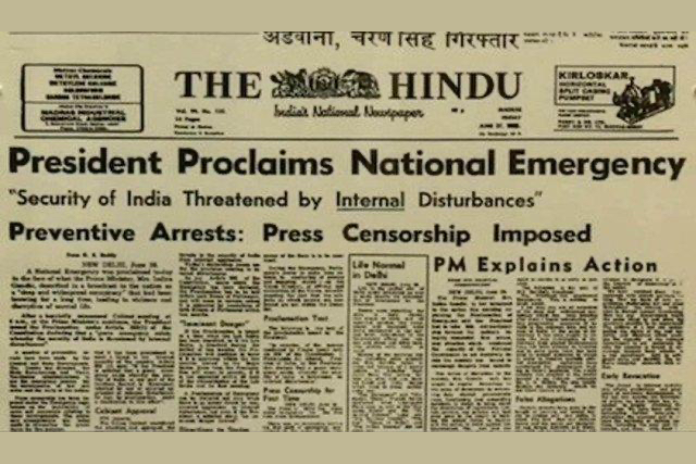
The Emergency imposed between 1975 and 1977 marked a defining moment in the history of Indian journalism. Declared under Article 352 on the grounds of “internal disturbance” by Prime Minister Indira Gandhi, this period witnessed unprecedented restrictions on democratic institutions. Political developments, including the Allahabad High Court judgement and opposition movements led by the Janata Party, contributed to the declaration of Emergency.
At this time, the Press Council of India was abolished and later reconstituted in 1978.
Effect on the Press
During the Emergency, Freedom of Speech and Expression was effectively suspended, and strict pre-censorship was imposed. News related to protests, political debates, and arrests was heavily controlled under the justification of maintaining public order. In some cases, electricity supply to printing presses was deliberately cut to prevent publication — a tactic reportedly used against newspapers like The Indian Express.
The media responded in different ways. Some publications resisted censorship by leaving editorial spaces blank or subtly criticising the regime, while others complied with government directives. Newspapers such as The Indian Express and The Statesman became symbols of resistance, whereas others, including The Times of India, were often criticised for accommodating state pressure. The concept of “public order” became an elastic justification for restricting journalistic freedom.
Post-Emergency Impact
After the Emergency ended in 1977, the Shah Commission, headed by Justice J.C. Shah, was established to investigate the period. The Commission described the Emergency as undemocratic and documented widespread misuse of power, including arbitrary arrests, detention of political opponents, and press censorship.
Another significant development was the 44th Constitutional Amendment, 1978. This amendment replaced the term “internal disturbance” with stricter conditions for declaring an Emergency, making future impositions more difficult. It also aimed to roll back several changes introduced through the 42nd Amendment. Additionally, the Right to Property was removed from the list of Fundamental Rights and reclassified as a constitutional right under Article 300A.
Right to Information: A Shift in Power Toward Citizens and Journalists
In 2005, the Right to Information (RTI) Act fundamentally reshaped the relationship between the state, citizens, and the media. The Act empowered individuals to seek official information from public authorities, strengthening transparency and accountability. For journalists, RTI became one of the most powerful tools for investigative reporting, encouraging a shift from allegation-driven journalism to document-based and evidence- based storytelling.
However, the Act also includes exemptions under Section 8, such as matters related to national security, personal information, cabinet papers, and ongoing investigations. Despite these limitations, RTI significantly enhanced journalistic access to verified data and strengthened democratic participation.
Modern Dilemmas: Defamation and the Watchdog Role of the Press
Even today, the balance between freedom and regulation remains contested. Defamation laws aim to protect the dignity and reputation of individuals and organisations, yet they can also create a chilling effect on investigative journalism. Influential personalities sometimes use legal pressure to discourage critical reporting. Thus, while defamation law safeguards personal rights, it often intersects uneasily with the press’s watchdog function.
Ultimately, the evolution of post-independence press laws reflects an ongoing negotiation between state regulation and journalistic freedom. Article 19(1)(a) remains the constitutional foundation of free expression, yet meaningful speech depends on access to accurate information. In this sense, the journey of Indian journalism continues to be shaped by the delicate balance between governance, ethics, and democratic accountability.
The author is working on a forthcoming book titled India’s Global Shift, which examines India’s evolving role in global governance, power transitions, and multilateral reform in the 21st century.