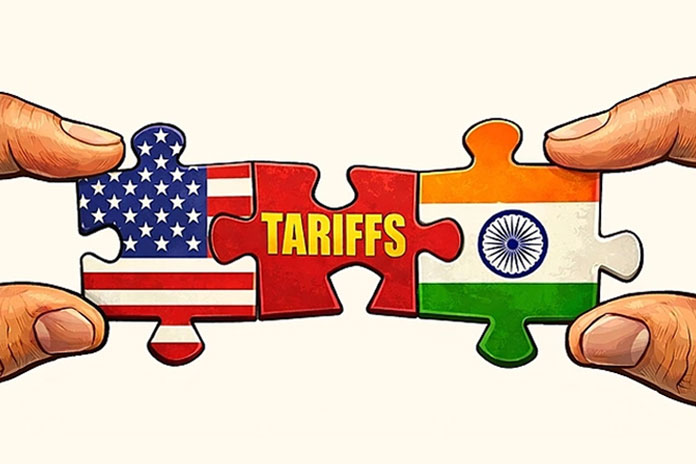
In the power corridors of Delhi back in July 2025, a group of top Indian specialists and technocrats gathered to discuss options. India had to decide and decide fast as U.S. President Donald Trump’s tariff deadline was approaching and large economic powers like the EU, Japan and South Korea had already buckled. The economic gulf between the U.S., a mammoth 30 trillion dollar economy and India, with its mere 3 trillion dollar economy lay in stark, open contrast. There was no comparison and no good options to deal with the tariffs, or so it seemed.
An audacious strategy was needed and this meeting was the perfect catalyst for it.
By that point, six months into President Trump’s second term in Office, almost every country in the world had experienced and been subjected to unorthodox pressure tactics on trade with the so called ‘Liberation Day’ tariff declarations of April 2025. But ironically, it was U.S. allies, especially across Europe, who were being squeezed the most: subjected to loud, public and blatant disregard. Already stinging from a severely lopsided trade deal with the U.S., the European Union and its bureaucracy were facing severe public pressure.
Thus Delhi’s decision to quietly reach out to the EU, through our friends in France, aiming to secure a rapid Free Trade Agreement by the end of 2025 was immediately welcomed and Brussels got to work in earnest.
India knew that alone, it was no match for the U.S. But if it could reach an FTA with the EU, and reach it fast, bringing together two major, powerful global economic blocks; bypassing the U.S. it would give Delhi an advantage in trade negotiations. After all, for all its power, Washington DC would not want to be left out from major global trade deals.
To be fair, the work on fast-tracking the intractable India-EU trade deal, that had been stuck in difficult negotiations for almost twenty years had begun in 2022, when the COVID Pandemic made both economies realise they needed to diversify their supply chains.
With the re-election of President Trump in November 2024, the negotiations had gained urgency, particularly on the European side and now with the looming large Trump trade tariffs, India also threw in its political weight in 2025.
Clear political directions were given, on both sides, to get a deal done as fast as possible and not squabble on small issues. India identified agriculture and dairy as its core red lines and the EU saw access for automobiles and large industries to the Indian market as crucial. With the right signals and intent, the results were quick and out there for the world to see.
The ‘Mother of all Deals’ was announced on 27 January 2027 in New Delhi, an India-EU FTA that many had written off and thought to be impossible.
And as the reverberations of global economics played out, within a week, on 2 February 2027, President Trump signed off on the long pending India-U.S. trade deal, due to increasing domestic political pressure in the U.S. with lawmakers in Congress fearing that America was loosing access to the world’s fastest growing major economy and on a critical relationship that the U.S. had dedicated 25 years to painstakingly building. Overnight, tariffs on India were reduced from 50% to 18% and sanctions on India were ended.
David had stood up to Goliath and survived.
While the details and fine print of the India-U.S. trade deal are not out yet, the Government of India has publicly declared that India has not buckled and the red lines on agriculture and dairy – the two critical mass employment sectors of the Indian economy are safe from heavily subsidised U.S. agricultural products.
With the Indian National Statistics Office estimating that India’s real GDP growth will be 7.4 per cent in financial year 2026, a period of high growth and low inflation has been secured with the certainty of two major back-to-back trade deals, with the EU and now U.S.
To become a developed nation by 2047, India needs 7-8 per cent annual growth. And investment is key to driving this growth. With fresh political and economic certainty in India-U.S. relations and India-EU relations, momentum is now in India’s favour. Estimates show corporate investment announcements between April and December in 2025 have already surged to a decade-high. Impact from the major domestic reforms on income tax and GST and notifications on labour codes done last year is already visible and is significantly boosting the economy.
While India must remain cautious until both the big trade deals with EU and US are ratified, for now at least India has secured its Goldilocks Zone – a sustained economic period defined by high growth and low inflation.
Meanwhile today, in the power corridors of Delhi, those same top specialists and technocrats could be seen confidently smiling and sharing a few stories over steaming cups of tea.