EDITORIAL
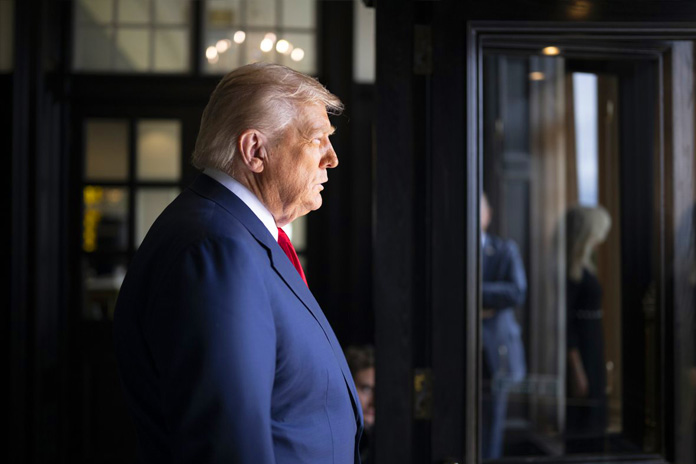
Over the past 24 hours, India has been at the receiving end of US President Donald Trump’s very loud, public and brazen style of social media proclamations. His rage and perhaps rant at India has turned into outright threats towards the Indian economy, leaving most Indians scratching their heads and asking whether this is the new ‘normal’ in Indo-US ties? Do we bend the knee and compromise or stand and face the might and ire of the world’s most powerful office and its current incumbent?
In short, the answer is neither. To capitulate and accept a trade agreement that compromises core national interests is not a part of Indian strategic decision-making. Similarly, to engage the White House in a very public and increasingly brutal spat is not in Indian interests or sensibility. After all, over the decades, Indo-US relations have undergone dramatic transformation. India is the big bet, America has made in the Indo-Pacific viz a viz its great power competition with China, and US is the future that most Indians have willingly chosen.
There is maturity built into the systematic and strategic bilateral relationship, crossing bipartisan political lines in both countries, with a large convergence of thought and action between the two nation’s operational bureaucratic, military and diplomatic institutions.
Yet, President Trump being President Trump, has his own sense and bearing of the world. No one disputes that in his heart he wants what’s best for America, namely the re-industrialisation of the American State, and tariffs are his way of achieving this reality. There is a certain audacity to Trump, that even his most stringent critics must grudgingly appreciate. He does what he says and he has said all along that he would impose stringent tariffs on India by the 1 August deadline.
So this should not have come as a surprise for us. And in the larger sense it hasn’t. But somehow the way he is now targeting India seems personal and more visceral rather than the usual pressure tactics the world has grown accustomed to. Is it because he feels betrayed by Indian Prime Minister Narendra Modi, who just the other day stood in the Indian Parliament and categorically denied that Trump played any role in mediating the India-Pakistan conflict in May 2025? Dashing any hope for a Nobel prize that President Trump apparently seems to desperately want.
Or is it because Trump is just frustrated with India and its refusal to budge and capitulate on trade, when even a powerful block like the European Union has? The Indo-US trade deal was supposed to be one of Trump administration’s early successes. Talks began in February 2025, even before the so called ‘Liberation Day Tariffs’ were announced. PM Narendra Modi was one of the first world leaders to meet President Trump in the White House in February and an ambitious India-US $500 billion bilateral trade target was set for 2030.
So what exactly went wrong?
In a nutshell it was two things: agriculture and dairy. During the trade negotiations over the past 6 months, the US has been seeking access to India’s agriculture and dairy sectors which is a very big red line for India. More than 700 million Indians are employed in these sectors, with farming being the backbone of the country. To open agriculture and dairy to foreign imports would devastate the livelihoods of hundreds of millions of Indians, something that is simply not acceptable. India is after all, still just a $2500 GDP per capita economy compared to the US, which has a GDP per capita of $85,000. Thus for American trade negotiators to expect that India would budge on this issue is not a reasonable thing to ask.
This is in fact one of the principal reasons that the India EU Free Trade Agreement has been stuck in negotiations for decades! Successive Indian governments have refused to compromise on these sectors. And even if there is some compromise, it would not satisfy the hunger of a US President who seeks the so-called ‘big ticket announcements’ in every trade deal, amounting to hundreds of billions of dollars, much like what he has done with the EU and Japan.
Therefore the burning question remains – where does all this leave India?
Government sources have strongly indicated that even in the worst case scenario, if no trade deal is reached with the United States – it would not be the end of the world. While they will strive for a balanced and mutually acceptable trade deal, they will not deeply compromise for one.
The more dangerous and immediate threat that the Government of India is concerned about is the Russian Secondary Sanctions Bill, which is looming in the US Senate. If the bill is passed and weaponised, then it will be akin to an economic nuke being hurled at India. Given the state and prices of the global oil market, India needs Russian energy to sustain its growing economy as previous unilateral western sanctions have already squeezed Iranian and Venezuelan oil out of the global market, both of whom have been traditional oil suppliers for India.
Buckling under threats of unilateral US sanctions, India cannot simply “switch-off its economy” due to lack of oil so to speak. If we have too, then we don’t deserve to be a major power of this world.
For the irony of the world’s most powerful man, the President of the United States of America, seeking validation from India through a lopsided trade-deal or superficial claims of mediation during conflict, is not lost on anyone.